Match Cut or Straight Cut: Two Ways to Join Scenes
Compare a match cut or straight cut by tracking image, movement, and rhythm, then choose the join that makes a scene change feel intentional.
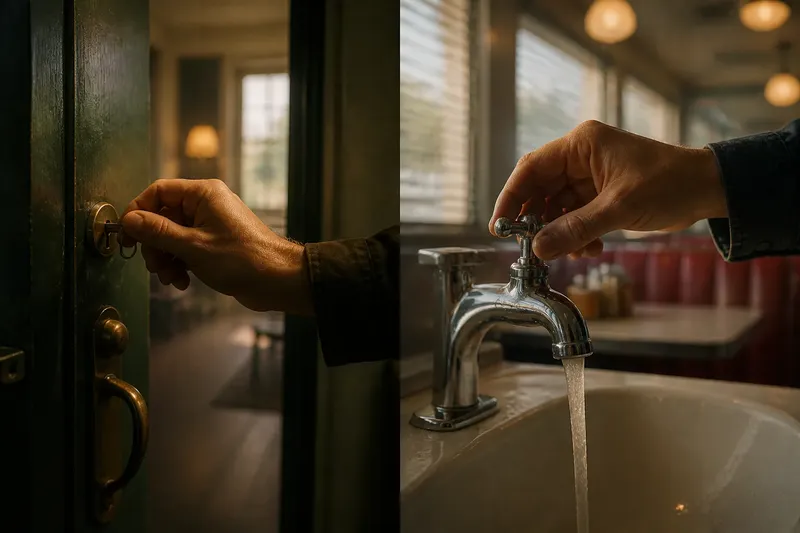
In an editing room, two scenes sit beside each other on the timeline: a hand turning a key, then a hand turning a tap. A match cut or straight cut can join them, but each gives the audience a different instruction. One carries a visual or kinetic link across the boundary; the other lets the new scene arrive without that bridge.
Neither is inherently smoother, smarter, or more dramatic. The useful choice depends on what the cut should make a viewer notice: a relationship between images, a change of place, a shift in pace, or simply the next event. A week of focused viewing and editing can make those differences easier to recognize in your own work.
Monday: Find the boundary
Start with a short sequence that changes scene. Watch it once without pausing and note the moment you realize the location, time, or activity has changed. Then replay the transition and look at the final image before the cut and the first image after it.
A straight cut is the basic, direct join from one shot to another. The picture changes at once. It may be a cut from a close view of a character at a kitchen counter to a wide view of a bus station, with no image or movement deliberately carried between them.
A match cut links the shots through a perceptible similarity. That link might be shape, color, composition, action, or movement. The images need not depict the same object: a circular plate followed by a circular streetlight can rhyme visually, while a person raising a cup followed by someone raising a phone can match an action.
Write down what you think connects the two shots, if anything. If the answer is “they simply follow each other,” you are probably looking at a straight cut. If the answer names a visible or moving correspondence, a match is doing additional work.
Tuesday: Track the visual link
For a match cut, inspect the frame around the edit rather than asking only whether two shots contain similar things. A strong visual match often places the corresponding shape or subject in a similar part of the frame, so the eye can carry its attention across the change.
Look for more than exact outlines. A bright window might lead to a white page; a dark doorway might connect to a shadowed tunnel. Similar color or contrast can create a quieter match than a precise geometric echo. The link may be immediate, or it may become clear after the new image has settled.
Now ask what the resemblance means in context. A visual rhyme can suggest a comparison, an association, or a sense that one scene answers another. It can also be purely elegant and slightly self-satisfied. Editing has no shortage of opportunities to admire its own penmanship.
During a viewing session, pause on both sides of the cut and describe the connection in plain words. If you need to explain the intended association at length, the match may be too subtle to register or too complicated for the available images. That does not automatically make it wrong, but it changes the effect from clear visual link to private puzzle.
Wednesday: Follow the movement
Movement offers another route into a match. A gesture can begin in one shot and appear to continue in another: an arm swings down, then a falling object enters the next scene on a similar path. The action need not be physically continuous. The resemblance is enough to make the cut feel connected.
Pay attention to direction, speed, and timing. If an object travels from left to right in the first shot, a second motion in the same direction may feel like a continuation. Reverse the direction or delay the second movement, and the join may feel more like a deliberate interruption.
A movement match can soften a scene change while still making it noticeable. It guides the eye through the cut, but the new setting or subject can transform the gesture’s meaning. That is useful when the point is both connection and change: the action carries over, while its context does not.
Try a simple viewing exercise with any two adjacent shots. Watch the edit first at normal speed, then replay it while following only the moving subject. Finally, watch again while ignoring movement and attending to framing. This separates the kinetic link from the visual one, even when both are present.
Thursday: Hear the rhythm
A straight cut can be abrupt in its image without feeling harsh in the sequence. If the outgoing shot ends at a natural pause, the next begins with a compatible pace, or the sound continues across the boundary, the transition may feel matter-of-fact. Directness describes the visual join, not a required emotional jolt.
Conversely, a match cut can make a scene change feel conspicuous. A carefully aligned image invites recognition; the viewer may register the construction before attending to the new scene. The pleasure is in spotting the connection, and that can briefly pull attention toward the edit itself.
Consider where the cut lands in the action. A straight cut during a pause can provide a clean reset. A cut during a gesture can produce a sharper change, while matching that gesture across scenes may create flow. The same pair of shots can therefore feel different depending on the chosen frame and the beat of the action.
For a practical comparison, imagine an invented scene in which a character closes a notebook at a desk, followed by a shot of a closed menu in a diner. If the editor aligns the covers and their position in the frame, the cut may suggest that the character’s workday has led into another routine. If the editor cuts instead from the notebook’s final page to a wide diner view, the scene change is more direct and the viewer is less prompted to compare objects. The observable difference is where attention goes: toward the visual echo or toward the new place.
Friday: Choose the join
When working with footage, make a temporary version of both edits if the material allows it. Keep the incoming and outgoing shots the same, then compare a direct cut with a version that aligns a shape or movement. Watch each in context, not only as a pair of still frames.
Use these questions to make the choice:
- What should the viewer notice first? Choose a match when a visual or kinetic relationship deserves attention; use a straight cut when the scene change itself is enough.
- Does the link read quickly? If a match is difficult to see at normal speed, adjust the framing or timing, or accept that a direct join may serve the moment better.
- Should the transition feel continuous? Matching movement can carry the eye forward. A straight cut can reset attention, though its rhythm depends on the shots around it.
- Does the association fit the scene? A match may imply comparison or connection. If that implication distracts from the intended meaning, remove the visual rhyme.
- Is the edit calling attention to itself? That can be welcome when the audience should notice the construction; otherwise, a plain cut may be less insistent.
Do not treat the two choices as opposing styles. A sequence can use direct cuts for most scene changes and reserve a match for a moment with a particular association. It can also place a match after several plain joins, allowing the visual link to stand out without turning every cut into a small announcement.
Saturday: Check the context
Watch the scene from before the transition through the next few shots. A match that seems clever in isolation may repeat information already made clear by the story. A straight cut that looks plain on the timeline may be exactly right because the surrounding rhythm has prepared the viewer for a clean change.
Also check whether the match survives the actual viewing conditions. A subtle color echo can disappear on a small screen or in a dim image, while a clear shape may remain legible. Do not add explanation to rescue a connection that the pictures do not establish; revise the cut or let the resemblance go.
If the cut feels wrong, identify the problem before changing it. Is the visual link hard to perceive, the movement mismatched, the pause too long, or the new scene arriving at the wrong emotional moment? Each calls for a different adjustment. Replacing a match with a straight cut may solve a distracting association, but it will not fix every timing problem.
Questions about cuts?
Is every cut between scenes a straight cut?
A direct join is commonly called a straight cut, but the transition can still contain a visual or movement match. The terms describe different aspects: one names a basic edit, while the other describes a relationship that links the images.
Can a match cut use different objects?
Yes. The objects can differ if the shots share a noticeable shape, composition, color, action, or movement. The audience needs a visible basis for the connection, not matching subject matter.
Does a match cut always feel smooth?
No. A match can be striking or disruptive if the new image changes context sharply, even while preserving a shape or gesture. Smoothness is one possible effect, not a requirement.
When is a straight cut the better choice?
Use it when the viewer should move on without being asked to compare images, or when a visual rhyme would suggest a connection the scene does not need. A direct cut can also make a change feel clean and decisive.
Sunday: Keep the useful note
End the week by replaying the sequence once and recording one sentence about what the chosen edit makes the viewer notice. Keep the note specific: “the raised hand carries the gesture into the next room” is more useful than “the transition feels cinematic.” If the sentence names an effect the images do not actually produce, revisit the cut.
For a match cut or straight cut, the best decision is the one that gives the scene the right kind of attention. A match asks the eye to connect; a straight cut lets it turn. The small but useful question is not which edit looks more skillful, but what the viewer should be looking at when the next scene begins.