Why a Camera Move Can Change the Meaning of a Walk
See how a camera move changes the meaning of a walk by shifting attention to the destination, the surrounding space, the pace, or a companion.
A character crosses a station concourse, but the camera keeps pace beside them instead of waiting at the exit. The destination remains visible; the tiled floor, passing commuters, and the character’s effort to stay composed become harder to ignore. That is the quiet leverage of a camera move: it can change the meaning of a walk by deciding what the audience attends to along the way.
When a moving shot feels wrong, the problem is not always clumsy operation. The camera may be emphasizing a different part of the journey than the scene requires, or it may be moving for reasons the viewer cannot read. Troubleshooting starts by naming the attention the shot should create, then examining the move that is actually on screen.
Destination loses its pull
A walk often has a practical objective: reach a door, meet someone, get out of sight. If the camera follows the character so closely that the destination disappears, the viewer can lose the question that gives the movement direction. The shot may still look active, but the character’s progress becomes difficult to judge.
This commonly happens when the camera is placed behind the character with a tight frame. The back of a coat can fill the image, while the route ahead is reduced to a narrow strip. A follow shot then records locomotion more clearly than intention.
Try preserving a readable fragment of the destination. The doorway need not dominate the frame; a visible sign, a patch of daylight, or the line of a corridor can keep the goal present while the camera follows. If the route is meant to feel uncertain, conceal it deliberately, then give the audience another cue—such as the character’s change of pace or glance—to show that the uncertainty belongs to the scene rather than the framing.
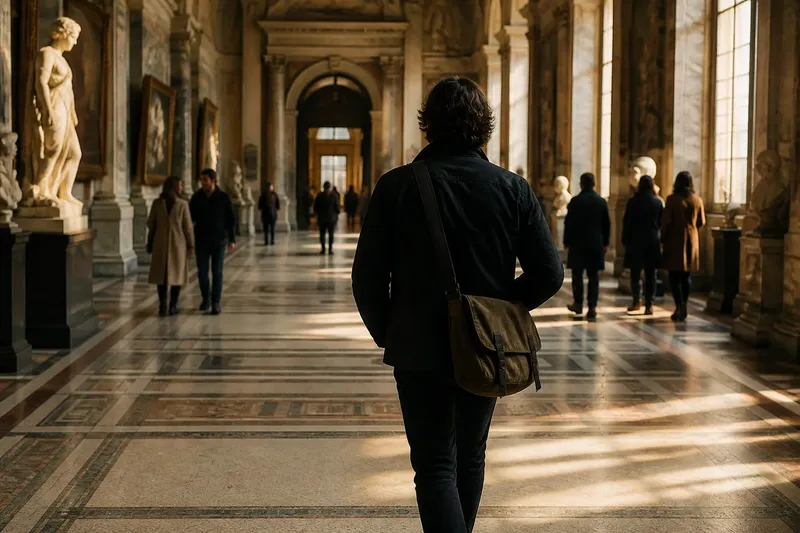
Imagine a courier hurrying through a museum corridor toward a gallery entrance. If the camera stays directly behind, the audience may mainly register a brisk walk. If it tracks slightly ahead and keeps the entrance at the frame’s edge, the courier’s repeated checks of that opening can make the approach feel wary. The camera has not changed the destination; it has changed how the character’s relation to it reads.
Space feels like scenery
Sometimes the destination is clear, yet the setting seems to contribute nothing. A moving camera can pass through a room without letting its shape, depth, or obstacles register. The background becomes a sliding decoration, and the walk could plausibly happen anywhere.
One cause is a route chosen for smoothness rather than meaning. A camera that glides along the easiest corridor may avoid the pillars, crowded tables, or changes in floor level that define the place. Another is a lens and framing combination that compresses the environment into a thin band behind the actor. The camera may be mobile while the space remains unreadable.
Look for a spatial feature the audience can track: a row of columns, a doorway that recedes, a window crossing the frame, or a change from open floor to a narrow passage. Let the camera’s path reveal that feature, rather than merely transporting the viewer beside the performer. A lateral move can expose depth through successive foreground objects; a backward move can keep the route ahead visible while the setting opens behind the character.
If the location is already visually busy, simplify the route instead of adding more movement. A slower camera crossing can let the audience distinguish the character from the crowd. If the place should feel confining, a path that repeatedly meets walls or furniture may make that pressure legible. The useful question is not whether the shot displays enough of the set, but whether the space changes the walk’s apparent difficulty or meaning.
Pace turns theatrical
A camera can make an ordinary walk feel hurried, ceremonial, hesitant, or unnervingly controlled. Trouble begins when the camera’s speed and the performer’s rhythm disagree without an apparent reason. A fast track beside a character taking measured steps can make the walk look oddly slow; a drifting camera may drain urgency from a purposeful stride.
Check the relationship between three rhythms: the actor’s footfalls and body movement, the camera’s travel, and the pace at which the background shifts. These do not need to match. Their mismatch does need to support an observable effect. A camera pulling away faster than the character advances can make the destination seem to recede. A camera that waits through a pause can make hesitation occupy the scene rather than pass as a minor beat.
Try adjusting one rhythm at a time. First ask the performer to hold the intended pace while the camera maintains a simple, steady relation. Then consider whether the camera should lag, draw level, or move ahead at a particular moment. This is more useful than asking for a generally “more tense” walk, which gives the crew a mood and no playable timing.
For a scene about a character trying to appear unhurried, a camera that quietly advances ahead can leave them working to catch up with the frame. If the camera instead walks at their exact pace, the same performance may read as calm control. The difference can be subtle, but the audience sees not just a person moving; it sees a relationship between effort and progress.
Companions lose their weight
A walk with another person is also a negotiation of attention. Who leads, who trails, who is allowed to leave the frame, and who must keep pace can say more than the route itself. A camera that stays attached to one face throughout may make the companion feel like background, even when the scene depends on their presence.
This often occurs when the shot is planned around a single operator’s preferred side or a performer’s cleanest mark. The resulting move may keep one person attractively framed while the other becomes a shoulder, a voice, or a blur at the edge. That can be appropriate for a scene of isolation, but it can undermine a conversation meant to feel mutual.
Choose the camera’s position according to the relationship in the scene. A two-shot that leaves room between the characters can make that gap visible. A move from one person’s side to the other can transfer attention as the balance of the exchange changes. If one character begins to fall behind, allowing the camera to stay with the leader can make the separation feel like an action, not a continuity accident.
During rehearsal, watch the walk without dialogue and note where each person changes pace, looks away, or waits. Then decide which of those moments should remain visible. A moving camera can preserve both performers in the frame, but inclusion alone does not make the relationship clear; spacing, eyelines, and who occupies the more favorable part of the composition still matter.
Movement feels unmotivated
A shot may be technically smooth and still seem to wander. This usually happens when the camera changes direction, distance, or framing without a corresponding shift in the scene. The audience may not consciously ask why the camera moved, but the unearned motion can call attention to itself.
Give each change a visible cue. The character turns toward someone; the camera reveals that person. The route narrows; the camera closes the frame. A pause stretches; the camera stops as well. The cue need not be dramatic. It only needs to make the move feel connected to something the viewer can see.
For a planned move, describe its purpose in ordinary terms: stay with the character, reveal the exit, let the companion fall behind, or make the corridor feel longer. Then review the shot with the sound muted and ask whether that purpose remains legible from the image. If the movement cannot be connected to an attention shift, a locked frame or a simpler path may serve the scene better.
For a moving shot, the route, rig, and operating plan depend on the location and equipment, so follow the relevant manufacturer instructions and production safety procedures rather than improvising around obstacles. That practical limit is also a useful creative one: a move should be designed for the space the crew can actually use.
Camera move questions?
Does a moving shot always make a walk feel faster?
No. Speed depends on the relation between camera movement, performer movement, framing, and the background’s apparent flow. A camera moving with a character can make the pace feel steady, while a camera retreating ahead may make the same walk seem to struggle toward its goal.
When should the camera stay still?
A fixed frame can make the character’s entrance, crossing, or departure carry the emphasis. It can also let the audience study a space while the character moves through it, without the camera directing attention toward one particular part of the route.
How can a walk show tension between two people?
Use visible changes in distance, pace, and position rather than relying only on facial expression. A camera that holds both people while one drifts behind can make separation readable; following only one may make the other’s loss of attention feel more final.
What should be checked in a moving-shot review?
Check whether the destination is readable, the space has a clear shape, the camera’s pace supports the performance, and the relevant companions remain visible. Then identify the exact moment the move should reveal or withhold something, and see whether the image does so.
Review the walk
When a camera move changes the meaning of a walk in an unwanted way, resist adding motion to make the shot feel more cinematic. Identify what has slipped out of attention: the destination, the character’s effort, the shape of the location, or the person walking beside them. Then adjust the route, distance, speed, or framing that controls that specific piece of information.
A useful review can be plain. Watch the shot once for the destination, once for the companions, and once for the space. If those passes reveal different problems, they are likely different problems, not one vague failure called “the camera move.” Keep the version that makes the walk’s purpose easiest to read, and let the floor do its quiet work.