The Quiet Sound Beneath Dialogue
Room tone beneath dialogue gives a scene a believable acoustic floor and lets pauses feel inhabited. Learn how to choose and shape it for the room.
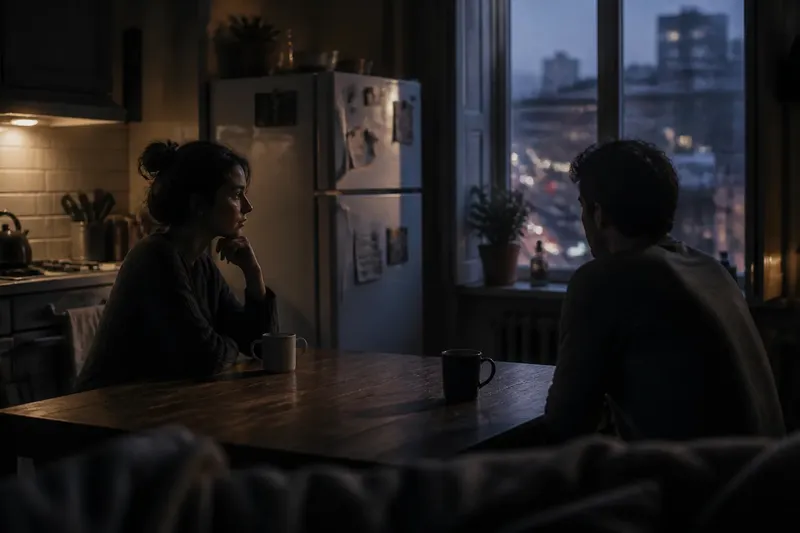
A character stops speaking, but the room does not. A refrigerator hums beyond the frame, traffic softens behind a window, or the air system leaves a faint steady hush. Room tone beneath dialogue gives a scene an acoustic floor: the space remains present even when the actors are quiet.
That floor is easy to miss when it works and conspicuous when it does not. A line may seem to float against silence, or the sound may change abruptly between edits. For a film editor or sound designer, the choice is not simply whether to add room tone. It is which kind of quiet best supports the place, the performance, and the shape of the pause.
What room tone does
Room tone is the quiet sound of a location or designed space, recorded or created without foreground action. It may include ventilation, distant street noise, electrical hum, soft reverberation, or the combined low-level character of a room. It is not necessarily silent, and it is not automatically the same as background music or a featured sound effect.
Its practical job is to keep edits from dropping into an unnatural vacuum. Production dialogue often contains a little ambience, but cuts between takes can expose differences in that background: one line carries a faint hiss, the next seems unnaturally clean. A continuous bed can help those edits belong to the same place.
Room tone also gives silence a texture. A pause in a tiled hallway has a different acoustic impression from a pause in a carpeted office. The audience may not identify the sound consciously; they can still sense whether the character seems to occupy a real environment or a soundproof void.
Three sound approaches
There are three useful broad options: preserve the location’s natural tone, build a controlled tonal bed, or let the scene fall toward near-silence. Each can work. The choice depends on how much the environment should participate in the scene.
Natural location tone
Using the actual room’s ambience suits scenes where place matters and the recorded background already has a coherent character. A kitchen with a low refrigerator hum, for instance, can feel more specific than a generic layer of “interior room” noise. The existing sound also tends to relate naturally to the dialogue recording, provided the tone remains consistent across the takes being joined.
The tradeoff is that real locations can be uneven. A passing vehicle, a changing ventilation cycle, or a crew movement may make one stretch of ambience unusable as a continuous bed. The sound editor can select a steadier portion, shape it carefully, or use another approach rather than forcing every irregularity to remain.
Designed room bed
A designed bed combines or creates sounds to suggest a room without relying on one untouched recording. It suits scenes whose production audio is noisy, inconsistent, or deliberately sparse, and it gives the sound team more control over the environment’s character. A quiet office might have a restrained ventilation layer and a distant, softened building presence, with no single sound demanding attention.
Control can become over-design. A bed that is too smooth may make the space feel generic; one with an obvious hum can pull attention away from a performance. The useful target is not a catalogue of audible details but a stable background whose components support the scene without announcing their separate existence.
Near-silence
Near-silence suits a scene in which environmental presence should recede and the audience should attend closely to breath, a small movement, or the absence of an expected sound. It can make a pause feel exposed rather than cozy. This is a deliberate contrast, not merely the result of forgetting to fill an edit.
Absolute digital silence can feel more artificial than a quiet, restrained bed, especially when dialogue suddenly ends at a cut. A near-silent approach may retain a trace of the room or the recording noise floor so that the transition feels intentional. The quieter the environment becomes, the more noticeable any change between lines can be.
Choosing the right approach
Start with the scene’s point of view. If the room is part of the character’s experience, preserve or build a tone that makes its presence legible. If the moment is about concentration, dread, or emotional exposure, a thinner bed may help. If the scene moves between conversational beats, a stable natural or designed bed can keep the space from disappearing between lines.
Then listen to the dialogue in context, not only to the isolated pauses. A tone that seems unobtrusive alone may mask consonants when layered under speech. Conversely, a bed that is barely audible beneath dialogue may become clear during a pause, which can be exactly what makes the pause feel occupied.
Consider how much variation the scene can carry. Natural room tone may be the clearest choice when its level and character remain consistent. A designed bed is useful when the recording changes enough to distract. Near-silence is an expressive option when the scene benefits from a noticeable reduction in environmental presence, but it asks for precise transitions.
Say an invented scene takes place in a small apartment kitchen, and the dialogue alternates between two takes with different levels of refrigerator hum. An editor could choose a steady portion of the quieter take, use it as a continuous bed, and ease it beneath both lines; the expected observable result is that the hum no longer jumps at the cut, while the pause still sounds like the same kitchen. If the hum feels too prominent against the performance, a subtler designed bed or a thinner near-silent treatment may serve better.
Where should the tone come from?
Can room tone be recorded separately?
Yes. A separate recording of the location’s quiet ambience can provide material for edits, especially when captured without dialogue or foreground movement. Its usefulness depends on whether the space and recording conditions still resemble the sound in the scene.
Should every pause contain room tone?
No. A pause can move toward near-silence when that change serves the scene, and some transitions may be covered by another sound. The important choice is whether the gap feels intentionally shaped rather than accidentally empty.
Is room tone the same as ambience?
The terms overlap in everyday post-production conversation, but ambience often refers more broadly to environmental background, including distinct elements such as distant traffic or birds. Room tone usually points to the quieter, more continuous acoustic character needed to hold dialogue edits together.
How loud should it be under dialogue?
There is no universal level that suits every performance or mix. Listen for whether the bed supports continuity without masking speech, and compare the dialogue and pauses at the intended playback level.
Shaping the transitions
Room tone is not only a sound choice; it is also an editing choice. A sudden change in background can expose a cut even when the spoken words join smoothly. Overlapping a steady bed across the edit can soften that change, while a carefully timed reduction can make a pause feel more exposed.
Fades need not be conspicuous. A very short, abrupt start can sound like a switch, while a long fade may make the room seem to swell. Editors can shape the bed around breaths and line endings, keeping the background steady where continuity matters and allowing a change where the scene calls attention to the silence.
Listen on more than one playback system when possible. Headphones can reveal a low hum or edit seam that small speakers hide; ordinary speakers can show whether a faint bed vanishes entirely in the mix. The goal is not to make every detail audible everywhere, but to avoid a distracting jump or a texture that competes with the actors.
When the room should change
Consistency is useful, but an unchanging bed is not always the right answer. A character may move farther from a window, close a door, or become more attentive to a sound that was previously background. In those cases, room tone can shift with the scene’s perspective rather than serving as a static patch.
The shift should have a perceptible reason. A gradual reduction in distant street noise as a door closes can make the new acoustic boundary clear. A sudden cut from lively ambience to a blank, quiet bed may instead read as a technical discontinuity unless the film establishes that contrast deliberately.
For scenes built around stillness, the most useful room tone may be the one that leaves room for attention. It can anchor dialogue, give a breath somewhere to exist, and make a pause belong to a particular place. Choose natural tone, designed bed, or near-silence according to what the scene asks the audience to notice; room tone beneath dialogue works best when its presence is felt more than heard.