The Borrowed Prop That Makes a Fictional Room Feel Lived In
A borrowed prop can make a fictional room feel lived in by giving a character a visible habit, a trace of history, and a reason to touch the space.
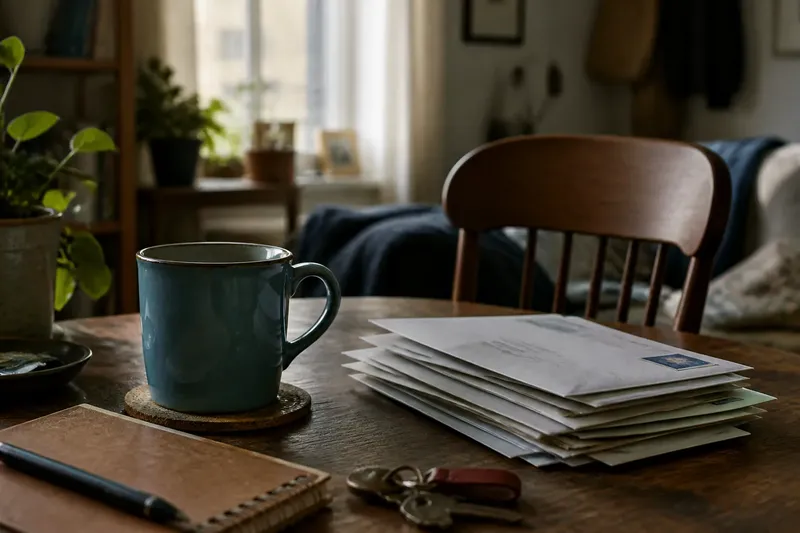
A chipped blue mug sits beside a stack of unopened mail, its handle turned toward the empty chair. In a fictional room, that small arrangement can tell us more than another framed photograph. A borrowed prop makes the room feel lived in when it carries a trace of one particular person’s habits, not simply a layer of visual clutter.
Choose a personal trace
“Borrowed” need not mean rented from a prop house. It describes an object that seems to have arrived from a character’s life rather than from the room’s decorating plan: a library book with a folded corner, a sewing tin, a cracked phone case, a takeaway menu kept under a magnet.
The object should suggest use without announcing a biography. A mug with tea rings says someone drinks from it; a mug printed with a slogan about being a lifelong loner tries to do the character’s work for them. The first leaves room for the audience to notice. The second arrives carrying its own subtitle.
Start with a habit that could plausibly leave a physical trace. Someone repairs things, reads in bed, keeps receipts, or feeds a houseplant unevenly. Then choose an object that belongs to that action. The link between person and prop gives the detail its force.
Borrowed prop design
For the art department, a character-specific object is a compact piece of borrowed prop design: it can establish routine, suggest a past, and give an actor something to handle. Those jobs do not need to happen all at once. A plain object with one distinctive sign of use often reads more clearly than an assortment of carefully aged possessions.
Wear should have a cause. The glossy patch on a book cover might come from a thumb resting in the same place; a bent teaspoon may have been kept in a desk drawer. Random scratches are texture. A repeated, plausible mark is evidence of contact.
- Ask who uses it. If the answer is “anyone,” its character value may be thin.
- Ask what action it invites. Holding, folding, opening, or setting it down can make it useful in a scene.
- Look for one specific trace. A repaired seam or worn corner gives the eye a legible clue.
- Check its visual weight. A bright label may pull attention away from the actor’s face.
- Decide whether it can return. A recurring object can gather meaning as the character’s behavior changes.
These are selection questions, not a demand that every prop carry symbolic freight. A room still needs ordinary things. The memorable object is effective partly because the rest of the set does not compete to be memorable.
Let use shape the frame
Placement can make an object feel habitual or staged. A paperback left open face-down beside a bed suggests interrupted reading. The same book centered upright on a bedside table can look arranged for a catalog, unless the character has a reason to display it.
Think about the camera’s view before adding detail. A worn patch may be invisible in a wide shot, while a high-contrast sticker becomes conspicuous from across the room. The prop does not need to be shown in close-up to matter, but its shape and position should remain readable at the scale the scene uses.
Allow a little irregularity. A stack of mail need not form a neat rectangle, and a chair may be slightly turned toward the window if that is where the character sits. The distinction is between purposeful disorder and a set dressed to look generically “messy.” One feels like a routine; the other looks like the room had a difficult morning on command.
Give actors a reason
A useful prop can support a small piece of behavior without demanding a speech. An actor may square a pile of receipts while avoiding a question, or reach for a familiar cup before noticing that it is gone. The action gives the object a relationship to the person, rather than leaving it as background decoration.
Say a character is a night-shift nurse who collects paperbacks but rarely finishes them. The set dresser places a dog-eared mystery beside the kettle, with a receipt marking a page and a second book tucked underneath. In a scene, the character can lift the book, find the marked page, and leave it open while making tea; the expected result is a visible routine and an interrupted intention, with no line explaining either.
The prop should be easy to handle in the way the scene requires. A loose lid, a delicate paper edge, or a noisy object may affect timing or continuity. Rehearsal can reveal whether the actor’s action feels natural and whether the object survives repeated handling. The aim is not to choreograph a symbolic gesture, but to give the performer a believable option.
When should a prop stay subtle?
How can a prop imply history without exposition?
Give it a visible trace of repeated use, repair, or care, then let the scene move on. The audience can register a familiar object before anyone explains where it came from.
Should the object be unique?
Not necessarily. A common object becomes specific through its condition, placement, or the character’s way of handling it. An ordinary key ring with one faded tag may carry more personality than an elaborate collectible.
When does a meaningful prop feel too obvious?
It tends to feel overemphatic when its message is already stated by dialogue, costume, and several nearby objects. Remove one or two supporting clues and see whether the remaining detail still belongs in the room.
Does every prop need a backstory?
No. Give a backstory only as far as it helps the design, performance, or continuity. A prop can feel convincing because it is handled consistently, even if nobody on set has written an account of its previous owners.
Keep the room coherent
A character-specific object works best among details that agree with its implied life. A well-used recipe notebook in a spotless kitchen may be a deliberate contrast, but the contrast should have a reason. Otherwise, the object reads as an isolated clue placed for the viewer rather than a possession that belongs there.
Check what happens across the scene. If the mug changes position between shots, or the paperback’s folded corner disappears, the room loses the quiet continuity that made the detail persuasive. A simple set photograph and a note about the object’s starting position can help the crew preserve its state.
For a fictional room that feels lived in, a borrowed prop does not need to explain a character. It needs to make one small action seem ordinary: reaching, repairing, saving, or forgetting. Choose the object by the trace it can carry, then let the scene leave enough silence for that trace to be seen.